

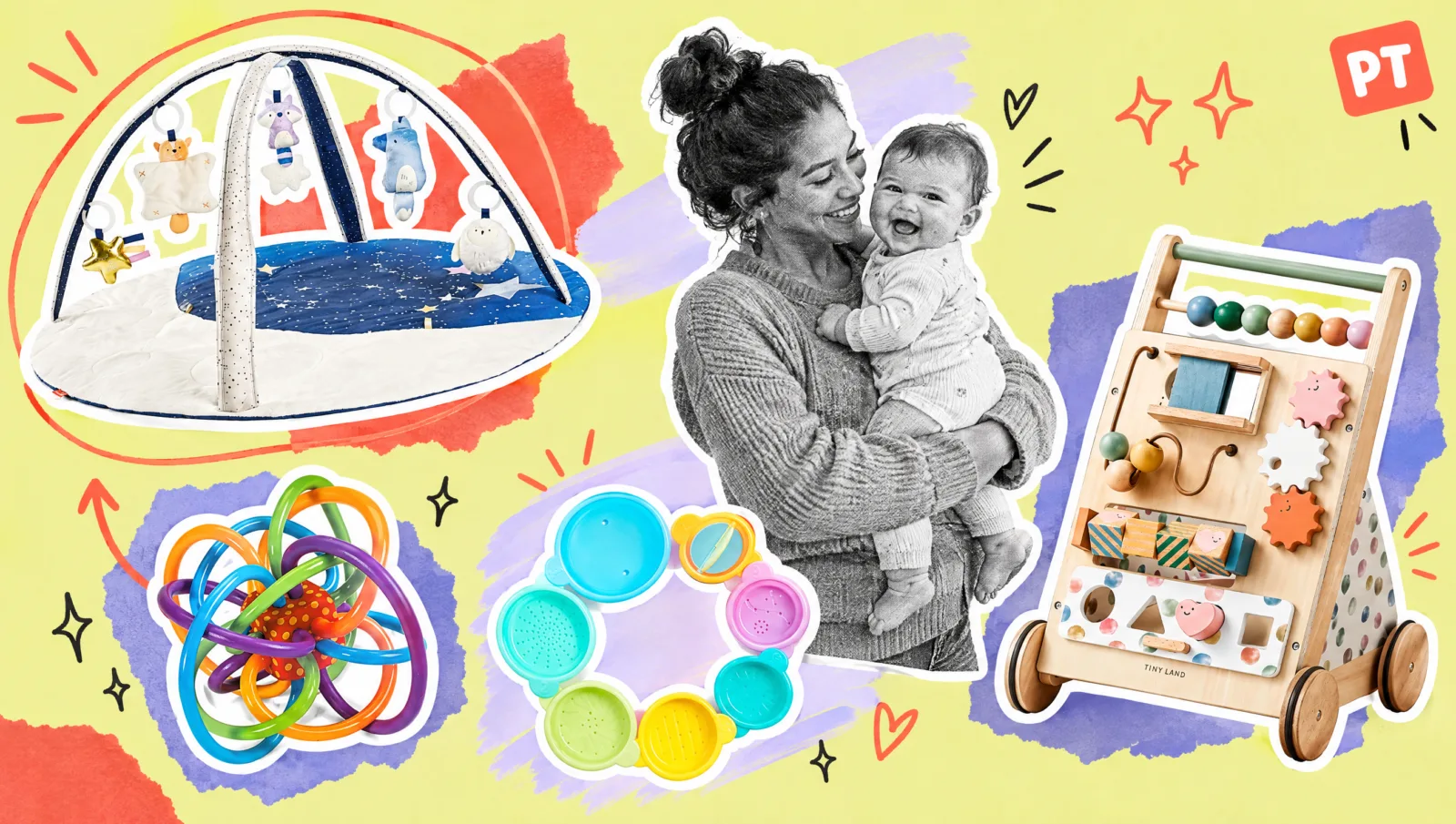
If you’ve ever stood in a toy aisle trying to guess what a five-month-old would actually play with, this guide is for you.
We built it around one question: what is the baby working on right now? In the first year, the answer changes every few months. Babies learn to reach for and grab things, then sit up and pass toys from hand to hand, then pull up to stand and fill and empty containers. A gift that fits that work is one they’ll come back to, and one the parents will be glad to have around.
Below, we’ve grouped our picks by three-month stretch and checked each one against safe-sleep and small-parts guidance. Whether you’re shopping for a shower, a first visit, a first birthday, or the holidays, find the stage the baby is in and start there.
One idea shaped this whole list. The American Academy of Pediatrics’ report “Selecting Appropriate Toys for Young Children in the Digital Era” found that simple, traditional toys support development better than electronic ones. With a simple toy, the baby has to come up with the play. With a toy that lights up and sings on its own, the toy does the playing and the baby watches.
The report also points out that good toys don’t need to be expensive, and it specifically discourages electronic toys for early language. Babies learn words through back-and-forth talk with the people who love them, and a talking toy can take the place of that. So you’ll notice almost nothing here needs batteries. That’s on purpose.
Parenthood Together earns a commission when you buy through links on this page, at no extra cost to you. We decide what belongs in a guide before we check whether it pays a commission, and we never accept payment for a recommendation.
0 to 3 months: gifts for looking, listening, and being held
In these first weeks, a baby’s world is very close up. Their vision is blurry beyond about a foot, so bold black-and-white patterns and the faces of the people holding them are what they can see best.
That’s why the most useful gifts at this stage are things a parent or caregiver uses with the baby: something to show them during tummy time, a soft mat to lie on side by side, a book to read out loud. These gifts are really invitations to spend a few quiet minutes together.
High-contrast cards or a soft black-and-white book. Tummy time is hard work for a newborn, and having something interesting to look at helps. Propped up in front of the baby, bold black-and-white images tend to hold a newborn’s attention longer than soft colors do. Baby’s Black and White Contrast Book is an accordion-style board book that stands up on its own, which is exactly what you want for a baby who can’t hold anything yet.
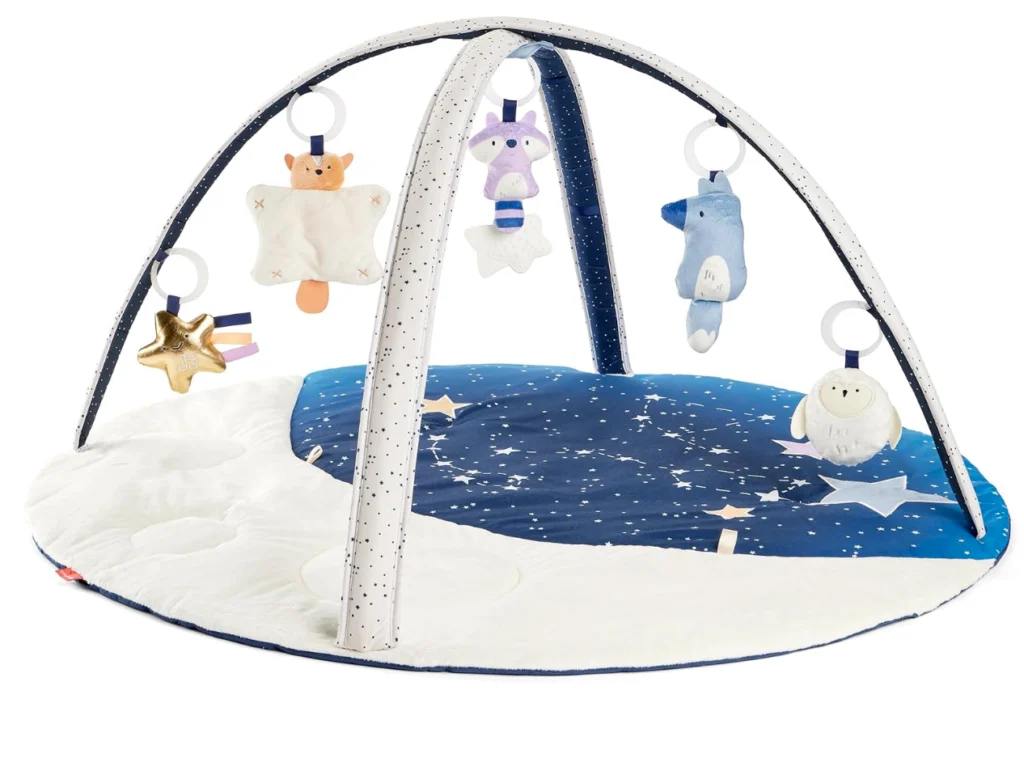
A play gym with a removable arch. Around month two or three, babies start swatting at things above them, and a play gym gives them something to aim for. Look for one where the hanging toys detach. Once the baby outgrows the arch, the mat keeps going as a soft spot on the floor for months. The Skip Hop activity mat comes with five removable toys, including a mirror, that can move down onto the mat once the baby spends more time on their tummy.
Board books, and lots of them. A newborn won’t follow the story, and that’s fine. Reading aloud from the very beginning is how the habit starts, and the baby gets to hear a familiar voice up close. Around five months, books start going straight into mouths, so chew-proof, washable ones are worth it.
A gentle note on crib gifts. We get the pull of a cozy crib. A soft quilt, a matching bumper, a plush bunny tucked in the corner all look so sweet. For now, though, those belong somewhere else. The AAP’s safe sleep guidance is for babies to sleep on their backs on a firm, flat surface with nothing else in the crib, because loose bedding and soft toys can cause suffocation or strangulation. If you’d love to give something cozy, a wearable blanket (often called a sleep sack) keeps a baby warm in a way that fits the guidance, and that plush bunny can sit on a shelf until the baby is older.
3 to 6 months: everything goes in the mouth
This is a fun stretch. Babies start reaching on purpose, holding on, and bringing everything they catch straight to their mouth. It can look messy, but mouthing is one of the main ways babies learn about things at this age: how something feels, how heavy it is, what shape it is. Good gifts here are easy to grab, safe to chew, and simple to wash.
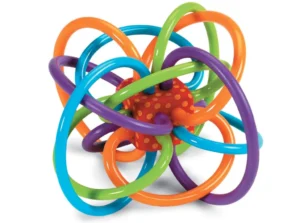
A toy that can be grabbed from any angle. Little hands are still clumsy, so open, loopy shapes work well because there’s no wrong way to catch one. The Manhattan Toy Winkel is a favorite for a reason. It’s a continuous maze of soft BPA-free loops with a rattle in the center, it’s rated from newborn, and it can go in the fridge to feel cool on sore gums once teething starts.
A soft rattle or crinkle toy with a wrist or foot strap. Around now, babies start to figure out cause and effect: when I do this, that happens. A rattle strapped to a wrist or ankle lets a baby discover that their own kicking makes a sound, and then you get to watch them do it again on purpose.
A natural rubber teether. Sophie la Girafe is the famous one, and she earns her reputation with a long neck and legs that are easy for small hands to grip. She’s a single piece of natural rubber with food-grade dyes and has been around for about sixty years. Whatever teether you choose, look for one solid piece with no small parts and nothing that can come off, since anything that goes in a baby’s mouth needs to stay in one piece.
A mirror with a soft handle. Babies love faces, and a baby-safe mirror gives them one to study up close. Long before they understand that the baby in the mirror is them, many will smile and babble right back at it.
6 to 9 months: sit, switch hands, bang it on the table
Sitting up changes a lot, because it frees both hands. Babies at this stage love passing a toy from one hand to the other, banging two things together, and dropping things to see what happens. It’s noisy, and it’s real learning. Toys that stack, nest, and make a satisfying sound are a great fit.
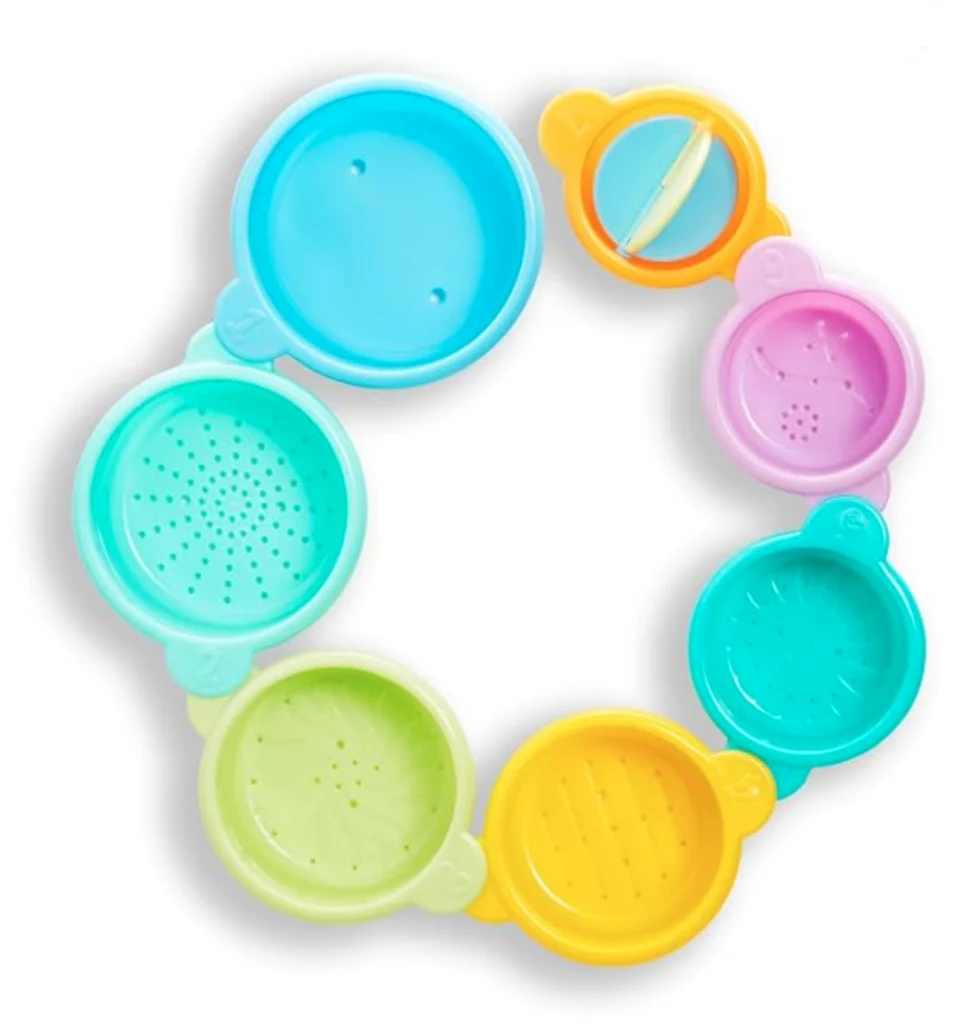
Stacking cups. If you only buy one thing from this guide, make it this. Stacking cups are inexpensive, and they grow with the baby: first for chewing and banging, then for nesting and hiding small toys, then for building towers to knock down. They go in the bath too, and they tend to stay interesting until around age three. Munchkin’s Connect-A-Cup set has seven cups that link, stack, and strain water, so it does double duty at bath time.
An object permanence box. The baby drops a ball into a hole and watches it roll out the other side. It sounds simple, and that’s the beauty of it: each time, they’re practicing the idea that something still exists when they can’t see it, which is the same idea that makes peekaboo so much fun at this age. A wooden object permanence box does exactly this. Check that the ball is large enough to pass the small-parts rule, since some inexpensive versions use smaller balls.
A push-button or dimple toy. Fat Brain’s Dimpl is the well-known one: silicone bubbles that pop through a frame, with no batteries and no sounds, so the baby’s own fingers make it work. We like the Dimpl Stack, which is five stacking cups with a popping bubble on each. It covers poking and stacking in one toy, and it’s rated for 6 months and up.
A soft book with flaps and textures. Lifting a flap to find something hiding underneath is one of a baby’s first games of surprise. Crinkly pages and different textures give curious hands something to explore while you read together.
9 to 12 months: up on two feet and into everything
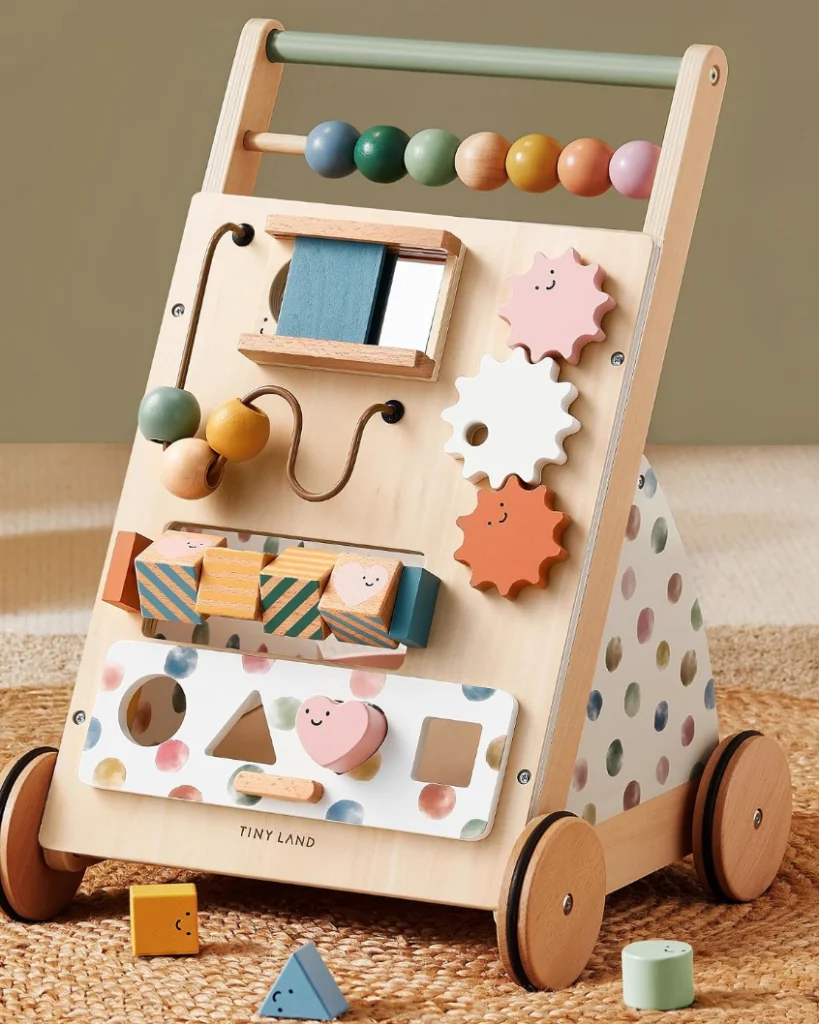
Once a baby starts crawling, pulling up, and cruising along the furniture, they want to move and they want to repeat things. The best gifts now give them a reason to stand, and something to do over and over until they’ve got it.
A push walker, if your floors allow it. A sturdy, weighted push toy gives a baby who’s ready to stand something steady to hold while they practice steps. It works best on floors where it won’t roll away too fast. The Tiny Land wooden walker has plenty of hands-on activities with no electronics, so it doubles as a play station on days the baby would rather sit. We’d pass on seated activity centers and anything a baby gets strapped into for long stretches, so they have more time to move around freely.
Nesting or sorting sets with bigger pieces. Putting things into containers and taking them back out is a favorite game right now. Before you buy, check every piece against the CPSC small-parts rule. A simple test: if a piece fits through a cardboard toilet paper tube, it’s a choking hazard for a child under three.
A ball drop or ramp toy. The baby drops a ball in the top and watches it roll down and out the bottom, every single time. That predictable result is exactly what makes it satisfying, and it’s why these toys get played with again and again.
Chunky knob puzzles. These are often still a bit hard at ten months and a great fit a few months later, so think of them as a gift to grow into. In the meantime, pulling the pieces out is its own game.
A real household object. A wooden spoon, a metal bowl, a set of measuring cups. The AAP’s point about simple toys applies here too, and everyday kitchen things give babies new shapes, sounds, and textures to explore. A wrapped set of measuring cups is a perfectly lovely first birthday gift.
When the nursery is already full…
If the baby you’re shopping for already has plenty of toys, these gifts help the whole family in a different way.
A contribution to a 529 or a savings account. Not flashy, and maybe the most valuable thing on this page, because it keeps growing long after the toys are outgrown. Our guide to accounts to open before your kid turns ten walks through the options.
Food. A delivered meal, a grocery gift card, or a few homemade frozen dinners take one daily decision off a new parent’s plate, which can mean a lot in the first three months.
Your time, with a date on it. “Tuesday morning, I’ll take the baby for two hours so you can sleep” is a gift. “Let me know if you need anything” is kind, but it leaves the parent to ask and plan. An offer with a day and time attached is much easier to say yes to.
Printed photos. A small album or a few framed prints from the first months is something the family can hold on to for years.
A library card and a first trip to use it. It’s free, it’s a sweet outing to share, and it opens the door to years of books.
What we’d skip (and why)
Toys that light up and play music while the baby watches. The AAP is unusually direct on this one. These toys can crowd out the talking and singing between a baby and their grown-ups, which is what actually builds language.
Walkers a baby sits inside. Infant walkers have a long injury record. They’re banned from sale in Canada, and the CPSC has acted on them repeatedly. A push walker that the baby stands behind and holds is a different product, and it’s a great pick.
A big pile of stuffed animals. They’re sweet, but they can’t go in the crib, and one or two is plenty to love in the first year.
Newborn-size clothes. Babies outgrow newborn sizes quickly, so sizing up means the outfit gets worn for longer. Holiday outfits have a short window too, so a festive onesie may only fit for one occasion. If you love it, buy it a size or two up.
Anything with a button battery, unless the battery compartment screws shut. A swallowed button battery can cause serious internal burns within hours, so this is one safety check worth doing every time.
What’s the best gift for a baby under one?
Match the gift to what the baby is learning to do. Under six months, a play gym and board books are the most useful picks. From six to twelve months, stacking cups and a ball drop toy earn their spot. If the nursery is already full, a 529 contribution, a delivered meal, or a few hours of help can mean more than another toy.
One last tip before you check out: buy for the stage the baby will be in when the gift is opened, not the stage they’re in today. Babies change quickly, so a toy that’s a little ahead of their skills will get used for longer than one they’ve already moved past.
And if you’re the parent, sharing a short wish list with family and friends can save everyone a return trip.
If you’re still deciding what the first year actually requires, our guide to baby items that are actually useful separates what you need from what’s marketed to you. And if you know someone who’s about to shop for a baby, send this their way.
Never miss an update. Subscribe to Between Us, our weekly newsletter.
Join the conversation at facebook.com/groups/parenthoodtogether